

Sciatica Treatment in Portage & Kalamazoo
Leg pain that travels from your back into your hip, thigh, or foot isn’t random. We identify the movement and mechanical pattern driving your symptoms so treatment is specific not routine.
Most patients are seen within 1-3 days.
Is This Sciatica?
• Pain shooting into the buttock or leg
• Tingling or numbness in the leg or foot
• Pain worse with sitting or bending
• Symptoms that come and go
• Leg pain worse than back pain
Why Our Approach Is Different
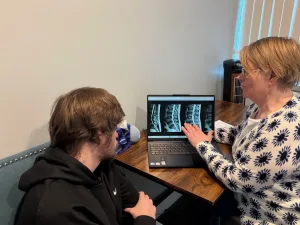
We don’t treat all sciatica the same. Your exam helps determine whether symptoms are being driven by disc irritation, nerve sensitivity, joint loading, or movement patterns—so care is matched to the problem.
How We Evaluate Sciatica
• Symptom response patterns to determine how your pain behaves with repeated movement
• Neurological screening when needed to assess strength, reflexes, and sensation
• Mechanical loading strategies to understand how your spine and leg symptoms respond to specific movements
This process helps us match treatment to your specific presentation rather than using a one-size-fits-all approach.
Sciatica FAQ
Sciatica describes a pattern of nerve-related leg pain. It is not a diagnosis by itself.
Common symptoms include:
- Pain radiating down one leg
- Burning, sharp, or electric-like pain
- Numbness or tingling
- Leg weakness
- Pain that worsens with sitting, bending, or prolonged standing
The way your symptoms respond to movement provides important information about the source of irritation.
Sciatica is most commonly associated with:
- Lumbar disc irritation or herniation
- Nerve root inflammation
- Spinal stenosis
- Mechanical movement dysfunction
The cause matters.
Different mechanisms require different approaches. Treating symptoms without understanding the driver often leads to temporary relief rather than lasting improvement.
Many patients in Portage and Kalamazoo ask this question.
In many cases, imaging is not immediately required.
Conservative care is often appropriate when:
• Strength is intact
• Symptoms are stable
• No red flag findings are present
Imaging may be recommended if:
• Progressive weakness develops
• Severe neurological symptoms are present
• Symptoms fail to improve
• Concerning findings emerge during evaluation
Care decisions are based on clinical findings — not routine protocol.
Treatment is active and progression-based.
Your plan may include:
• Direction-specific exercises
• Targeted hands-on care
• Load management strategies
• Movement retraining
• Structured progression to reduce recurrence
The goal is not dependence on ongoing treatment.
The goal is clarity, stability, and confident movement.